1021 stories
·
0 followers

Trump FCC investigates The View, reportedly says "fake news" will be punished

1 Share

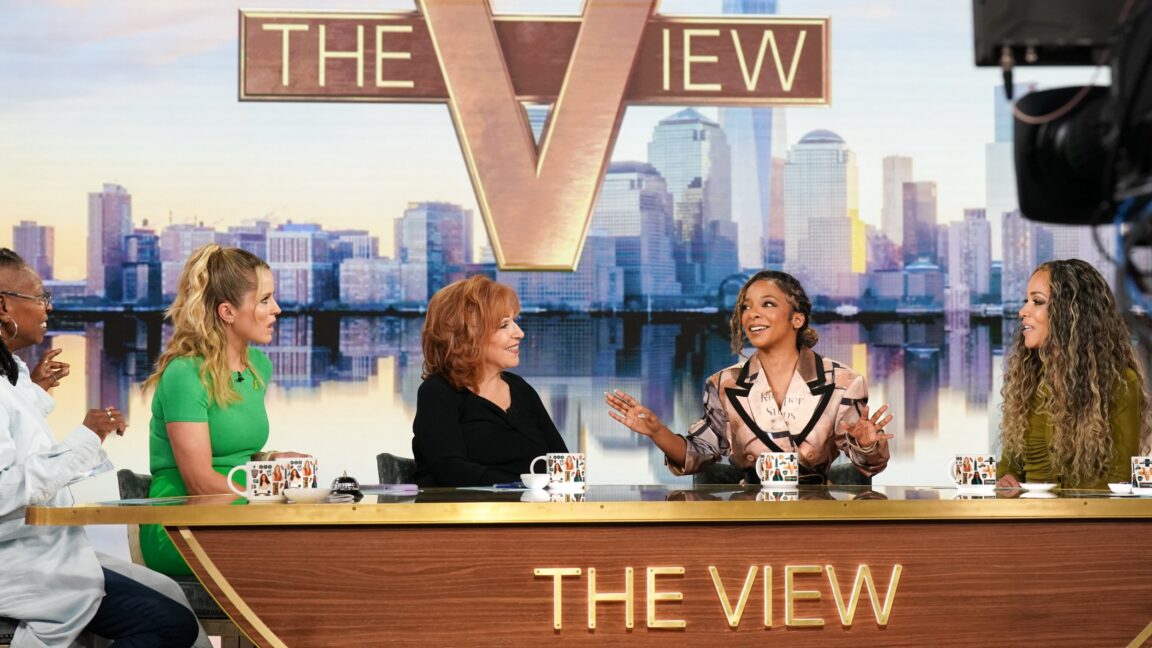
The Federal Communications Commission is reportedly investigating ABC’s The View in what FCC Democrat Anna Gomez called an attempt to intimidate critics of the Trump administration.

“Let’s be clear on what this is. This is government intimidation, not a legitimate investigation," Gomez said in a statement Friday night. "Like many other so-called ‘investigations’ before it, the FCC will announce an investigation but never carry one out, reach a conclusion, or take any meaningful action. The real purpose is to weaponize the FCC’s regulatory authority to intimidate perceived critics of this administration and chill protected speech."

The FCC hasn't announced the investigation but previously gave several indications that it would occur sooner or later. After pressuring ABC to suspend Jimmy Kimmel, FCC Chairman Brendan Carr said in September that it would be "worthwhile to have the FCC look into whether The View and some of these other programs" are violating the agency's equal-time rule. The Carr FCC followed that up in January by issuing a warning to late-night and daytime talk shows that they may no longer qualify for the bona fide news exemption to the equal-time rule.

Fox News reported Friday that the FCC is launching an investigation into The View "amid the agency's crackdown on equal time for political candidates." A source at the FCC told Fox that the probe was triggered by the show's interview with Texas Democratic Senate candidate James Talarico.

"Fake news is not getting a free pass anymore," Fox News quoted its FCC source as saying. Fox said its source indicated that ABC would have to provide "equal airtime for Republican candidates on the ballot like incumbent Republican Texas Sen. John Cornyn and his primary rivals," and for "Ahmad Hassan, the little-known candidate running against Talarico and [US Rep. Jasmine] Crockett in the Democratic primary."

President Trump posted a link to the Fox News story on his Truth Social account. The investigation was also confirmed by Reuters, which reported on Saturday that a source said the FCC opened a probe into whether the "daytime talk show violated equal time rules for interviews with political candidates after an appearance by a Democratic Texas Senate candidate."

We contacted the FCC today and will update this article if it provides any information on the reported investigation.

FCC fights Trump's war against media

In July, a White House spokesperson called The View co-host Joy Behar an “irrelevant loser” after she said Trump was jealous of former President Barack Obama. Trump has frequently called on the FCC to revoke licenses from ABC and other networks. The FCC issues licenses to individual broadcast stations, not national news networks, but many affiliated stations are owned and operated by the network.

Although the FCC is classified as an independent agency under US law, Carr has declared that the FCC is no longer independent from the White House and made it clear he takes orders from Trump. While former FCC chairs Jessica Rosenworcel and Ajit Pai rejected Trump's calls to revoke broadcast licenses from news organizations that Trump dislikes, Carr has repeatedly threatened station licenses on Trump's behalf. During the Kimmel controversy, Carr said that stations could face fines or license revocations if they continued to run Kimmel's show.

Gomez, the only Democratic commissioner on the FCC, urged "broadcasters and their parent networks to stand strong against these unfounded attacks and continue exercising their constitutional rights without fear or favor.” She said that despite the pressure the FCC is exerting with its equal-time rule, "the First Amendment protects the right of daytime and late-night programs to cover newsworthy issues and express viewpoints without government interference."

As for The View, Fox News said it was told by its source that ABC owner Disney "never made an equal-time filing to the FCC regarding Talarico's recent appearance, which would implicitly indicate to the FCC that Disney believes The View is bona fide news and would be exempt from the policy."

Bona fide news exemption

The equal-time rule, formally known as the Equal Opportunities Rule, generally requires that stations giving time to one political candidate must provide comparable time and placement to an opposing candidate if an opposing candidate makes a request. The rule has an exemption for candidate appearances on bona fide news programs, and entertainment talk shows have generally been treated as bona fide news programs for this purpose.

The FCC Media Bureau's January 21 public notice to broadcast TV stations said that despite a 2006 decision in which the FCC exempted The Tonight Show with Jay Leno from the rule, current entertainment shows may not qualify for that exemption. "Importantly, the FCC has not been presented with any evidence that the interview portion of any late night or daytime television talk show program on air presently would qualify for the bona fide news exemption," the notice said.

The Media Bureau's January 21 notice said the equal-time rule applies to broadcast TV stations because they "have been given access to a valuable public resource (namely, spectrum)," and that compliance with "these requirements is central to a broadcast licensee’s obligation to operate in the public interest."

The FCC notice got this detail wrong, according to Harold Feld, a longtime telecom attorney who is senior VP of consumer advocacy group Public Knowledge. The equal-time rule actually applies to cable channels, too, he wrote in a January 29 blog post.

"Yes, contrary to what a number of people think, including, annoyingly, the Media Bureau which gets this wrong in its recent order, this is not a 'public interest obligation' for using spectrum," Feld wrote. "It’s a conditional right of access (like leased access for cable) that members of Congress gave themselves (and other candidates) because they recognized the power of mass media to shape elections." The US law applies both to broadcast stations using public spectrum and "community antenna television," the old name for cable TV, Feld pointed out.

This doesn't actually mean that people can file FCC complaints against the Fox News cable channel, though, Feld wrote. This is because the FCC "has consistently interpreted Section 315(c) since it was added as applying only to 'local origination cablecasting,' meaning locally originated programming and not the national cable channels that cable operators distribute as part of their bundle," he wrote.

Leno ruling just one of many

In any case, Feld said the Media Bureau's "guidance ignores all of the other precedent that creates settled law as to how the FCC evaluates eligibility for an exemption on which broadcast shows have relied." While the FCC cited its Jay Leno decision, Feld said the Leno ruling was "merely one of a long line of FCC decisions expanding the definition of 'news interview' and 'news show.'"

The FCC started loosening its definitions of news shows and news interviews in the mid-1980s, Feld wrote. "In what many consider a landmark decision in 1984, the FCC held that the Phil Donahue Show—a daytime interview show—qualified as a bona fide news show and that interviews on the show were bona fide news interviews if they met the same criteria as those on traditional news shows," he wrote. "The FCC rapidly broadened the range of shows to include mixed entertainment/news programs such as Good Morning America, Sally Jessy Raphael (much more 'tabloid' style), and Howard Stern (back when he was a 'shock jock' on broadcast)."

The long line of FCC decisions indicated that "the fact that a program included segments designed solely for entertainment did not automatically disqualify an appearance by a candidate from the exemption provided (a) the candidate was selected by the show for 'newsworthiness;' (b) the show was regularly scheduled (and therefore not a campaign event); and (c) the show controlled the interview questions and editing," Feld wrote.

Feld said the FCC public notice indicates that under the current leadership, even traditional news shows might not be given the bona fide exemption if the FCC determines the show is "designed to 'advance the candidacy' of a particular individual." If Carr punishes ABC or another network, the target might be able to prove in court that the FCC overstepped its authority. But as seen in the Kimmel episode, Carr doesn't need to take any official action to cause a problem for a media company.

"As is often the case, the fact that a broadcaster would ultimately win if it ever got to court matters less than the pain selective enforcement causes," Feld wrote.

Read full article

Comments


Read the whole story
Share this story
Delete

NIH head, still angry about COVID, wants a second scientific revolution

1 Share

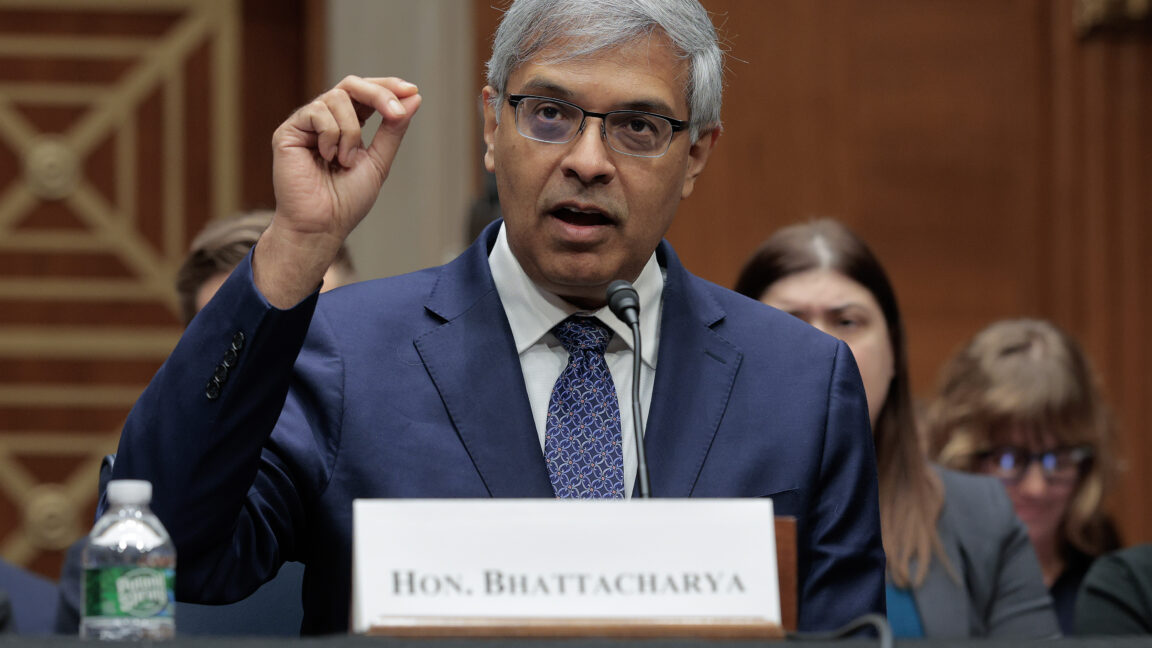
At the end of January, Washington, DC, saw an extremely unusual event. The MAHA Institute, which was set up to advocate for some of the most profoundly unscientific ideas of our time, hosted leaders of the best-funded scientific organization on the planet, the National Institutes of Health. Instead of a hostile reception, however, Jay Bhattacharya, the head of the NIH, was greeted as a hero by the audience, receiving a partial standing ovation when he rose to speak.

Over the ensuing five hours, the NIH leadership and MAHA Institute moderators found many areas of common ground: anger over pandemic-era decisions, a focus on the failures of the health care system, the idea that we might eat our way out of some health issues, the sense that science had lost people's trust, and so on. And Bhattacharya and others clearly shaped their messages to resonate with their audience.

The reason? MAHA (Make America Healthy Again) is likely to be one of the only political constituencies supporting Bhattacharya's main project, which he called a "second scientific revolution."

In practical terms, Bhattacharya's plan for implementing this revolution includes some good ideas that fall far short of a revolution. But his motivation for the whole thing seems to be lingering anger over the pandemic response—something his revolution wouldn't address. And his desire to shoehorn it into the radical disruption of scientific research pursued by the Trump administration led to all sorts of inconsistencies between his claims and reality.

If this whole narrative seems long, complicated, and confusing, it's probably a good preview of what we can expect from the NIH over the next few years.

MAHA meets science

Despite the attendance of several senior NIH staff (including the directors of the National Cancer Institute and National Institute of Allergy and Infectious Diseases) and Bhattacharya himself, this was clearly a MAHA event. One of the MAHA Institute's VPs introduced the event as being about the "reclaimation" of a "discredited" NIH that had "gradually given up its integrity."

"This was not a reclamation that involved people like Anthony Fauci," she went on to say. "It was a reclamation of ordinary Americans, men and women who wanted our nation to excel in science rather than weaponize it."

Things got a bit strange. Moderators from the MAHA Institute asked questions about whether COVID vaccines could cause cancer and raised the possibility of a lab leak favorably. An audience member asked why alternative treatments aren't being researched. A speaker who proudly announced that he and his family had never received a COVID vaccine was roundly applauded. Fifteen minutes of the afternoon were devoted to a novelist seeking funding for a satirical film about the pandemic that portrayed Anthony Fauci as an egomaniacal lightweight, vaccines as a sort of placebo, and Bhattacharya as the hero of the story.

The organizers also had some idea of who might give all of this a hostile review, as reporters from Nature and Science said they were denied entry.

In short, this was not an event you'd go to if you were interested in making serious improvements to the scientific method. But that's exactly how Bhattacharya treated it, spending the afternoon not only justifying the changes he's made within the NIH but also arguing that we're in need of a second scientific revolution—and he's just the guy to bring it about.

Here's an extensive section of his introduction to the idea:

I want to launch the second scientific revolution.

Why this grandiose vision? The first scientific revolution you have... very broadly speaking, you had high ecclesiastical authority deciding what was true or false on physical, scientific reality. And the first scientific revolution basically took... the truth-making power out of the hands of high ecclesiastical authority for deciding physical truth. We can leave aside spiritual—that is a different thing—physical truth and put it in the hands of people with telescopes. It democratized science fundamentally, it took the hands of power to decide what's true out of the hands of authority and put it in the hands of ridiculous geniuses and regular people.

The second scientific revolution, then, is very similar. The COVID crisis, if it was anything, was the crisis of high scientific authority geting to decide not just a scientific truth like "plexiglass is going to protect us from COVID" or something, but also essentially spiritual truth. How should we treat our neighbor? Well, we treat our neighbor as a mere biohazzard.

The second scientific revolution, then, is the replication revolution. Rather than using the metrics of how many papers are we publishing as a metric for success, instead, what we'll look at as a metric for successful scientific idea is 'do you have an idea where other people [who are] looking at the same idea tend to find the same thing as you?' It is not just narrow replication of one paper or one idea. It's a really broad science. It includes, for instance, reproduction. So if two scientists disagree, that often leads to constructive ways forward in science—deciding, well there some new ideas that may come out of that disagreement

That section, which came early in his first talk of the day, hit on themes that would resurface throughout the afternoon: These people are angry about how the pandemic was handled, they're trying to use that anger to fuel fundamental change in how science is done in the US, and their plan for change has nearly nothing to do with the issues that made them angry in the first place. In view of this, laying everything out for the MAHA crowd actually does make sense. They're a suddenly powerful political constituency that also wants to see fundamental change in the scientific establishment, and they are completely unbothered by any lack of intellectual coherence.

Some good

The problem Bhattacharya believes he identified in the COVID response has nothing to do with replication problems. Even if better-replicated studies ultimately serve as a more effective guide to scientific truth, it would do little to change the fact that COVID restrictions were policy decisions largely made before relevant studies could even be completed, much less replicated. That's a serious incoherence that needs to be acknowledged up front.

But that incoherence doesn't prevent some of Bhattacharya's ideas on replication and research priorities from being good. If they were all he was trying to accomplish, he could be a net positive.

Although he is a health economist, Bhattacharya correctly recognized something many people outside science don't: Replication rarely comes from simply repeating the same set of experiments twice. Instead, many forms of replication happen by poking at the same underlying problem from multiple directions—looking in different populations, trying slightly different approaches, and so on. And if two approaches give different answers, it doesn't mean that either of them is wrong. Instead, the differences could be informative, revealing something fundamental about how the system operates, as Bhattacharya noted.

He is also correct that simply changing the NIH to allow it to fund more replicative work probably won't make a difference on its own. Instead, the culture of science needs to change so that replication can lead to publications that are valued for prestige, job security, and promotions—something that will only come slowly. He is also interested in attaching similar value to publishing negative results, like failed hypotheses or problems that people can't address with existing technologies.
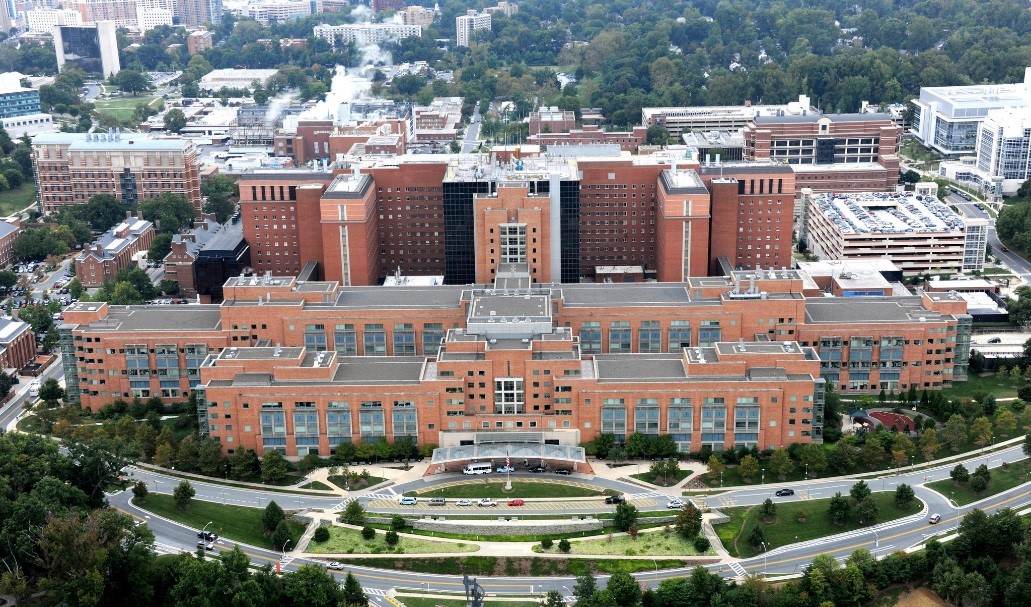
The National Institutes of Health campus. Credit: NIH

Bhattacharya also spent some time discussing the fact that NIH grants have become very risk-averse, an issue frequently discussed by scientists themselves. This aversion is largely derived from the NIH's desire to ensure that every grant will produce some useful results—something the agency values as a way to demonstrate to Congress that its budget is being spent productively. But it leaves little space for exploratory science or experiments that may not work for technical reasons. Bhattacharya hopes to change that by converting some five-year grants to a two-plus-three structure, where the first two years fund exploratory work that must prove successful for the remaining three years to be funded.

I'm skeptical that this would be as useful as Bhattacharya hopes. Researchers who already have reason to believe the "exploratory" portion will work are likely to apply, and others may find ways to frame results from the exploratory phase as a success. Still, it seems worthwhile to try to fund some riskier research.

There was also talk of providing greater support for young researchers, another longstanding issue. Bhattacharya also wants to ensure that the advances driven by NIH-funded research are more accessible to the public and not limited to those who can afford excessively expensive treatments—again, a positive idea. But he did not share a concrete plan for addressing these issues.

All of this is to say that Bhattacharya has some ideas that may be positive for the NIH and science more generally, even if they fall far short of starting a second scientific revolution. But they're embedded in a perspective that's intellectually incoherent and seems to demand far more than tinkering around the edges of reproducibility. And the power to implement his ideas comes from two entities—the MAHA movement and the Trump administration—that are already driving changes that go far beyond what Bhattacharya says he wants to achieve. Those changes will certainly harm science.

Why a revolution?

There are many potential problems with deciding that pandemic-era policy decisions necessitate a scientific revolution. The most significant is that the decisions, again, were fundamentally policy decisions, meaning they were value-driven as much as fact-driven. Bhattacharya is clearly aware of that, complaining repeatedly that his concerns were moral in nature. He also claimed that "during the pandemic, what we found was that the engines of science were used for social control" and that "the lockdowns were so far at odds with human liberty."

He may be upset that, in his view, scientists intrude upon spiritual truth and personal liberty when recommending policy, but that has nothing to do with how science operates. It's unclear how changing how scientists prioritize reproducibility would prevent policy decisions he doesn't like. That disconnect means that even when Bhattacharya is aiming at worthwhile scientific goals, he's doing so accidentally rather than in a way that will produce useful results.

This is all based on a key belief of Bhattacharya and his allies: that they were right about both the science of the pandemic and the ethical implications of pandemic policies. The latter is highly debatable, and many people would disagree with them about how to navigate the trade-offs between preserving human lives and maximizing personal freedoms.

But there are also many indications that these people are wrong about the science. Bhattacharya acknowledged the existence of long COVID but doesn't seem to have wrestled with what his preferred policy—encouraging rapid infection among low-risk individuals—might have meant for long COVID incidence, especially given that vaccines appear to reduce the risk of developing it.

Matthew Memoli, acting NIH Director prior to Bhattacharya and currently its principal deputy director, shares Bhattacharya's view that he was right, saying, "I'm not trying to toot my own horn, but if you read the email I sent [about pandemic policy], everything I said actually has come true. It's shocking how accurate it was."

Yet he also proudly proclaimed, "I knew I wasn't getting vaccinated, and my wife wasn't, kids weren't. Knowing what I do about RNA viruses, this is never going to work. It's not a strategy for this kind [of virus]." And yet the benefits of COVID vaccinations for preventing serious illness have been found in study after study—it is, ironically, science that has been reproduced.

A critical aspect of the original scientific revolution was the recognition that people have to deal with facts that are incompatible with their prior beliefs. It's probably not a great idea to have a second scientific revolution led by people who appear to be struggling with a key feature of the first.

Political or not?

Anger over Biden-era policies makes Bhattacharya and his allies natural partners of the Trump administration and is almost certainly the reason these people were placed in charge of the NIH. But it also puts them in an odd position with reality, since they have to defend policies that clearly damage science. "You hear, 'Oh well this project's been cut, this funding's been cut,'" Bhattacharya said. "Well, there hasn't been funding cut."

A few days after Bhattacharya made this statement, Senator Bernie Sanders released data showing that many areas of research have indeed seen funding cuts.
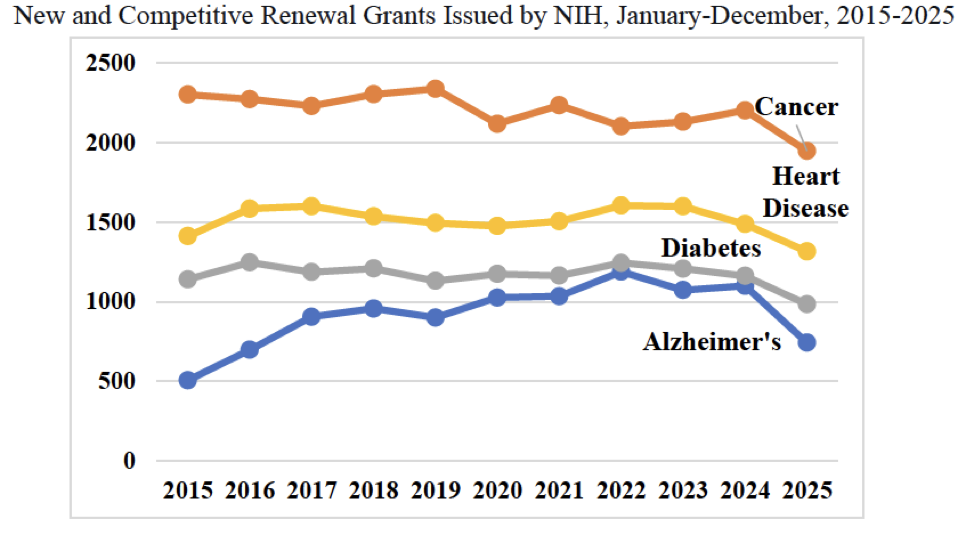
Image of a graph with a series of colored lines, each of which shows a sharp decline at the end. Bhattacharya's claims that no funding had been cut appears to be at odds with the data. Credit: Office of Bernard Sanders

Bhattacharya also acknowledged that the US suffers from large health disparities between different racial groups. Yet grants funding studies of those disparities were cut during DOGE's purge of projects it labeled as "DEI." Bhattacharya was happy to view that funding as being ideologically motivated. But as lawsuits have revealed, nobody at the NIH ever evaluated whether that was the case; Matthew Memoli, one of the other speakers, simply forwarded on the list of grants identified by DOGE with instructions that they be canceled.

Bhattacharya also did his best to portray the NIH staff as being enthused about the changes he's making, presenting the staff as being liberated from a formerly oppressive leadership. "The staff there, they worked for many decades under a pretty tight regime," he told the audience. "They were controlled, and now we were trying to empower them to come to us with their ideas."

But he is well aware of the dissatisfaction expressed by NIH workers in the Bethesda Declaration (he met with them, after all), as well as the fact that one of the leaders of that effort has since filed for whistleblower protection after being placed on administrative leave due to her advocacy.

Bhattacharya effectively denied both that people had suffered real-world consequences in their jobs and funding and that the decision to sideline them was political. Yet he repeatedly implied that he and his allies suffered due to political decisions because... people left him off some email chains.

"No one was interested in my opinion about anything," he told the audience. "You weren't on the emails anymore."

And he implied this sort of "suppression" was widespread. "I've seen Matt [Memoli] poke his head up and say that he was against the COVID vaccine mandates—in the old NIH, that was an act of courage," Battacharya said. "I recognized it as an act of courage because you weren't allowed to contradict the leader for fear that you were going to get suppressed." As he acknowledged, though, Memoli suffered no consequences for contradicting "the leader."

Bhattacharya and his allies continue to argue that it's a serious problem that they suffered no consequences for voicing ideas they believe were politically disfavored; yet they are perfectly comfortable with people suffering real consequences due to politics. Again, it's not clear how this sort of intellectual incoherence can rally scientists around any cause, much less a revolution.

Does it matter?

Given that politics has left Bhattacharya in charge of the largest scientific funding agency on the planet, it may not matter how the scientific community views his project. And it's those politics that are likely at the center of Bhattacharya's decision to give the MAHA Institute an entire afternoon of his time. It's founded specifically to advance the aims of his boss, Secretary of Health Robert F. Kennedy Jr., and represents a group that has become an important component of Trump's coalition. As such, they represent a constituency that can provide critical political support for what Bhattacharya hopes to accomplish.

Close-up of sterile single-use syringes individually wrapped in plastic and arranged in a metal tray, each containing a dose of COVID-19 vaccine. Vaccine mandates played a big role in motivating the present leadership of the NIH. Credit: JEAN-FRANCOIS FORT

Unfortunately, they're also very keen on profoundly unscientific ideas, such as the idea that ivermectin might treat cancer or that vaccines aren't thoroughly tested. The speakers did their best not to say anything that might offend their hosts, in one example spending several minutes to gently tell a moderator why there's no plausible reason to think ivermectin would treat cancer. They also made some supportive gestures where possible. Despite the continued flow of misinformation from his boss, Bhattacharya said, "It's been really great to be part of administration to work for Secretary Kennedy for instance, whose only focus is to make America healthy."

He also made the point of naming "vaccine injury" as a medical concern he suggested was often ignored by the scientific community, lumping it in with chronic Lyme disease and long COVID. Several of the speakers noted positive aspects of vaccines, such as their ability to prevent cancers or protect against dementia. Oddly, though, none of these mentions included the fact that vaccines are highly effective at blocking or limiting the impact of the pathogens they're designed to protect against.

When pressed on some of MAHA’s odder ideas, NIH leadership responded with accurate statements on topics such as plausible biological mechanisms and the timing of disease progression. But the mere fact that they had to answer these questions highlights the challenges NIH leadership faces: Their primary political backing comes from people who have limited respect for the scientific process. Pandering to them, though, will ultimately undercut any support they might achieve from the scientific community.

Managing that tension while starting a scientific revolution would be challenging on its own. But as the day's talks made clear, the challenges are likely to be compounded by the lack of intellectual coherence behind the whole project. As much as it would be good to see the scientific community place greater value on reproducibility, these aren't the right guys to make that happen.

Read full article

Comments


Read the whole story
Share this story
Delete

What should I do if a wait call reports WAIT_ABANDONED?

2 Shares

If you call a wait function like Wait­For­Single­Object and receive the code WAIT_ABANDONED, what does it mean and what should you do?

The documentation says that WAIT_ABANDONED means that you successfully claimed a mutex, but the thread that previously owned the mutex failed to release the mutex before it exited. This could be an oversight because the code encountered a code path that forgot to release the mutex. Or it could be because the thread crashed before it could release the mutex.

The documentation also suggests that “If the mutex was protecting persistent state information, you should check it for consistency.” This is to handle the second case: The thread crashes before it can release the mutex. If the purpose of the mutex was to prevent other threads from accessing the data while it is in an inconsistent state, then the fact that the thread crashed while holding the mutex means that the data might still be in that inconsistent state.

Now, maybe you have no way to check whether the data is in an inconsistent state or have no way to repair it if such an inconsistent state is discovered. (Most people don’t bother to design their data structures with rollback or transactions, because the point of the mutex was to avoid having to write that fancy code in the first place!) In that case, you really have only two choices.

One option is to just cover your ears and pretend you didn’t hear anything. Just continue operating normally and hope that any latent corruption is not going to cause major problems.

Another option is to give up and abandon the operation. However, if that’s your choice, you have to give up properly.

The abandoned state is not sticky; is reported only to the first person to wait for the mutex after it was abandoned. Subsequent waits succeed normally. Therefore, if you decide, “Oh it’s corrupted, I’m not touching it,” and release the mutex and walk away, then the next person to wait for the mutex will receive a normal successful wait, and they will dive in, unaware that the data structures are corrupted!

One solution is to add a flag inside your data that says “Possibly corrupted.” The code that detects the WAIT_ABANDONED can set that flag, and everybody who acquires the mutex can check the flag to decide if they want to take a chance by operating on corrupted data.

I’m not saying that you have to do it that way, but it’s a choice you’re making. In for a penny, in for a pound.

In summary, here are some options when you encounter an abandoned mutex:

  • Try to fix the problem.
  • Ignore the problem.
  • Give up and create a warning to others.
  • Give up and make everybody else think that everything is fine.

The final choice doesn’t make sense, because if you’re going to make everybody else think that everything is fine, then that’s the same as having everybody else simply ignore the problem. In which case, you may as well ignore the problem too!

Related reading: Understanding the consequences of WAIT_ABANDONED.

Bonus chatter: Don’t forget that if you get WAIT_ABANDONED, the mutex is owned by you, so make sure to release it.

The post What should I do if a wait call reports <CODE>WAIT_<WBR>ABANDONED</CODE>? appeared first on The Old New Thing.

Read the whole story
Share this story
Delete

The World's First Sodium-Ion Battery in Commercial EVs - Great at Low Temperatures

1 Share
Long-time Slashdot reader Geoffrey.landis shared this report from InsideEVs: Chinese battery giant CATL and automaker Changan Automobile are preparing to put the world's first passenger car powered by sodium-ion batteries on public roads by mid-2026. And if the launch is successful, it could usher in an era where electric vehicles present less of a fire risk and can better handle extreme temperatures. The CATL Naxtra sodium-ion battery will debut in the Changan Nevo A06 sedan, delivering an estimated range of around 400 kilometers (249 miles) on the China Light-Duty Test Cycle. From there, the battery will roll out across Changan's broader portfolio, including EVs from Avatr, Deepal, Qiyuan and Uni, the company said. "The launch represents a major step in the industry's transition toward a dual-chemistry ecosystem, where sodium-ion and lithium-ion batteries complement each other to meet diverse customer needs," CATL said in a press release... It delivers 175 watt-hours per kilogram of energy density, which is lower than nickel-rich chemistries but roughly on par with lithium ion phosphate batteries... Where the Naxtra battery really stands out, however, is cold-weather performance. CATL says its discharge power at -30 degrees Celsius (-22 degrees Fahrenheit) is three times higher than that of lithium ion phosphate batteries.

Read more of this story at Slashdot.

Read the whole story
Share this story
Delete

A New Era for Security? Anthropic's Claude Opus 4.6 Found 500 High-Severity Vulnerabilities

1 Share
Axios reports: Anthropic's latest AI model has found more than 500 previously unknown high-severity security flaws in open-source libraries with little to no prompting, the company shared first with Axios. Why it matters: The advancement signals an inflection point for how AI tools can help cyber defenders, even as AI is also making attacks more dangerous... Anthropic debuted Claude Opus 4.6, the latest version of its largest AI model, on Thursday. Before its debut, Anthropic's frontier red team tested Opus 4.6 in a sandboxed environment [including access to vulnerability analysis tools] to see how well it could find bugs in open-source code... Claude found more than 500 previously unknown zero-day vulnerabilities in open-source code using just its "out-of-the-box" capabilities, and each one was validated by either a member of Anthropic's team or an outside security researcher... According to a blog post, Claude uncovered a flaw in GhostScript, a popular utility that helps process PDF and PostScript files, that could cause it to crash. Claude also found buffer overflow flaws in OpenSC, a utility that processes smart card data, and CGIF, a tool that processes GIF files. Logan Graham, head of Anthropic's frontier red team, told Axios they're considering new AI-powered tools to hunt vulnerabilities. "The models are extremely good at this, and we expect them to get much better still... I wouldn't be surprised if this was one of — or the main way — in which open-source software moving forward was secured."

Read more of this story at Slashdot.

Read the whole story
Share this story
Delete

Is the 'Death of Reading' Narrative Wrong?

2 Shares
Has the rise of hyper-addictive digital technologies really shattered our attention spans and driven books out of our culture? Maybe not, argues social psychologist Adam Mastroianni (author of the Substack Experimental History): As a psychologist, I used to study claims like these for a living, so I know that the mind is primed to believe narratives of decline. We have a much lower standard of evidence for "bad thing go up" than we do for "bad thing go down." Unsurprisingly, then, stories about the end of reading tend to leave out some inconvenient data points. For example, book sales were higher in 2025 than they were in 2019, and only a bit below their high point in the pandemic. Independent bookstores are booming, not busting; at least 422 new indie shops opened in the United States last year alone. Even Barnes & Noble is cool again. The actual data on reading, meanwhile, isn't as apocalyptic as the headlines imply. Gallup surveys suggest that some mega-readers (11+ books per year) have become moderate readers (1-5 books per year), but they don't find any other major trends over the past three decades. Other surveys document similarly moderate declines. For instance, data from the National Endowment for the Arts finds a slight decrease in the percentage of U.S. adults who read any book in 2022 (49%) compared to 2012 (55%). And the American Time Use Survey shows a dip in reading time from 2003 to 2023. Ultimately, the plausibility of the "death of reading" thesis depends on two judgment calls. First, do these effects strike you as big or small...? The second judgment call: Do you expect these trends to continue, plateau, or even reverse...? There are signs that the digital invasion of our attention is beginning to stall. We seem to have passed peak social media — time spent on the apps has started to slide. App developers are finding it harder and harder to squeeze more attention out of our eyeballs, and it turns out that having your eyeballs squeezed hurts, so people aren't sticking around for it... Fact #2: Reading has already survived several major incursions, which suggests it's more appealing than we thought. Radio, TV, dial-up, Wi-Fi, TikTok — none of it has been enough to snuff out the human desire to point our pupils at words on paper... It is remarkable, even miraculous, that people who possess the most addictive devices ever invented will occasionally choose to turn those devices off and pick up a book instead. The author mocks the "death of reading" hypothesis for implying that all the world's avid readers "were just filling time with great works of literature until TikTok came along."

Read more of this story at Slashdot.

Read the whole story
Share this story
Delete
Next Page of Stories